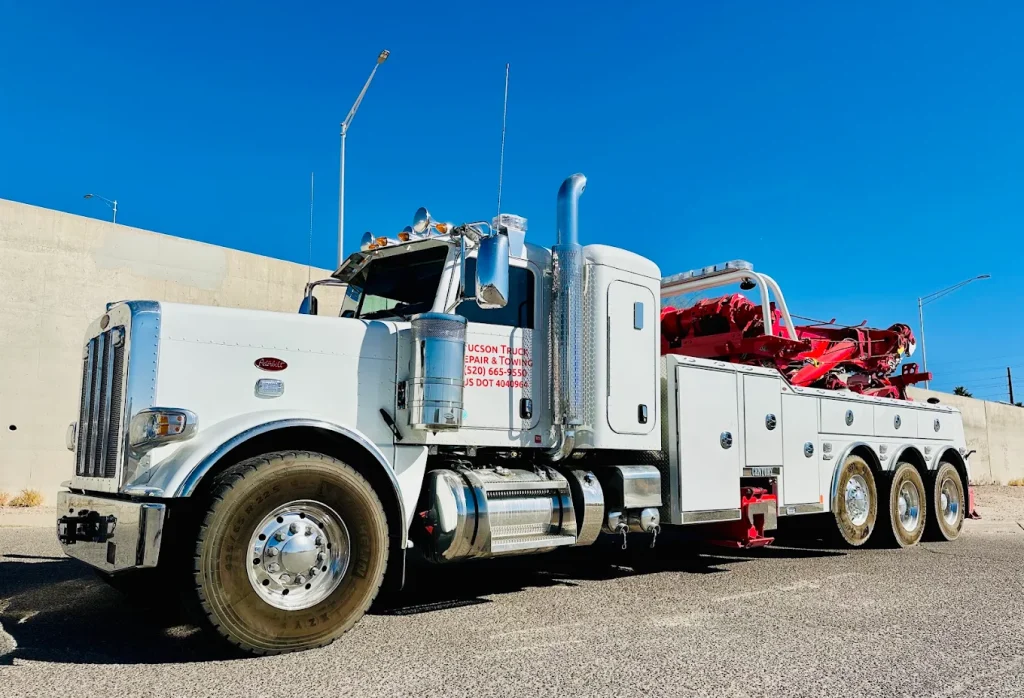
Rotator recovery is typically needed when a disabled, overturned, jackknifed, or immobilized commercial truck cannot be recovered safely with a conventional heavy-duty tow truck alone. A rotator wrecker provides the reach, lifting capacity, stability, and controlled movement required to reposition semi-trucks and trailers in difficult or hazardous locations.
These situations may involve an overturned tractor-trailer, a truck below the roadway, shifted cargo, severe collision damage, unstable terrain, or restricted access around the vehicle. In each case, the recovery team must consider the truck’s position, weight, mechanical condition, cargo, surrounding hazards, and available attachment points before moving the vehicle.
At Tucson Truck Repair & Towing, we use specialized heavy recovery equipment, including a 50-ton rotator and a 35-ton wrecker, to handle complex commercial truck incidents throughout Tucson and Southern Arizona. We also provide advanced semi-truck and trailer repairs, allowing us to recover the vehicle, diagnose the underlying problem, and complete major repairs when needed.
What Is a Rotator Wrecker?
A rotator wrecker is a heavy recovery truck equipped with a hydraulic boom mounted on a rotating turntable that can work from multiple angles. Unlike a conventional wrecker, which may need to be moved several times to establish a different pulling angle, a rotator can adjust its boom while remaining stabilized in one position.
Rotator recovery equipment commonly includes:
- A rotating hydraulic boom
- Heavy-duty winches and recovery lines
- Stabilizing outriggers
- Specialized rigging equipment
- Load-management controls
- Heavy towing components
These systems allow trained operators to lift, rotate, upright, and reposition large commercial vehicles with greater control.
The rotating boom is especially useful when the recovery truck has limited room to maneuver. This may occur along a narrow highway shoulder, beside a concrete barrier, near an embankment, inside a crowded truck yard, or at an accident scene where traffic restricts equipment placement.
When Is a Rotator Needed for Heavy Recovery?
Not every disabled semi-truck requires a rotator. A conventional heavy-duty wrecker may be sufficient when the truck is upright, stable, accessible, and suitable for towing.
A rotator is generally needed when the position, weight, damage, cargo, or surrounding conditions require more reach, lifting capacity, or control than conventional towing can provide.
Overturned Semi-Trucks and Trailers
An overturned tractor-trailer must be stabilized before it can be returned to an upright position. The recovery team must evaluate the tractor, trailer, cargo, axle configuration, road surface, center of gravity, and extent of the damage.
Simply pulling an overturned vehicle from one direction may cause it to shift unexpectedly. It may also place excessive stress on the frame, suspension, trailer body, cargo, or recovery equipment.
A rotator allows the recovery team to establish controlled lifting and pulling points. The boom can be positioned to help manage the truck’s movement throughout the uprighting process. Depending on the incident, additional wreckers, support vehicles, or cargo-handling equipment may also be required.
Jackknifed Tractor-Trailers
A jackknife occurs when the tractor and trailer fold toward each other at a severe angle. The vehicle may block several traffic lanes and place significant pressure on the fifth wheel, landing gear, frame, axles, and trailer components.
Even when the engine remains operational, the truck may be unable to move safely. Damage to the steering, driveline, suspension, air system, or coupling components may prevent the vehicle from being driven or conventionally towed.
Rotator equipment can help reposition the tractor or trailer while maintaining control over the load. Because the boom can rotate, the recovery team can apply force from an appropriate direction without repeatedly moving the entire recovery truck around the scene.
Trucks Below the Roadway
Semi-trucks may leave the roadway because of a collision, mechanical failure, unstable shoulder, poor visibility, severe weather, or an evasive maneuver. Once a tractor-trailer enters a ditch, median, wash, or embankment, the recovery becomes more difficult.
The vehicle’s angle may limit access to usable attachment points. Soft soil, loose gravel, steep slopes, and roadside barriers can also restrict where the recovery equipment can be positioned.
A rotator may be able to reach over a barrier or down an embankment while remaining stabilized on firmer ground. Multiple winch lines can be used to control the truck’s movement and reduce the risk of rolling, sliding, or shifting during extraction.
Shifted or Unstable Cargo
Cargo movement can significantly change a trailer’s center of gravity. This becomes especially dangerous when the trailer is overturned, partially rolled, leaning, or resting on uneven terrain.
Before the vehicle is moved, the recovery team may need to determine whether the cargo should be secured, transferred, or partially unloaded. Attempting to recover an unstable trailer without addressing its load could cause another rollover or place excessive force on damaged trailer components.
Rotator equipment can support controlled lifting during a cargo transfer or trailer repositioning. The recovery plan should account for cargo weight, trailer condition, access to the load, and the possibility of additional movement.
Severe Collision Damage
A tractor-trailer involved in a major collision may have damaged wheels, axles, suspension parts, steering components, landing gear, frame sections, or driveline components. The truck may remain upright but still be unsafe to tow using conventional methods.
A rotator may be used to lift a damaged portion of the truck, separate connected vehicles, reposition a trailer, or place the vehicle where it can be prepared for towing.
Controlled lifting can help prevent compromised parts from dragging across the roadway or causing further damage during removal.
Limited Access Around the Vehicle
Some recovery scenes do not provide enough room for a standard heavy-duty wrecker to line up directly with the disabled truck.
Concrete barriers, parked trailers, buildings, loading docks, traffic, overhead obstacles, or narrow shoulders may restrict positioning. Because a rotator boom can work from several directions, the recovery truck may remain in a stable location while the operator adjusts the pulling or lifting angle.
This flexibility can reduce unnecessary equipment movement and help the recovery team work within a confined area.
How Does Rotator Equipment Improve Recovery Safety?
Heavy recovery involves moving extremely heavy commercial vehicles, often near active traffic or unstable terrain, often beside active traffic or on unstable terrain. Safety depends on more than the size of the tow truck. It requires appropriate equipment, careful planning, proper rigging, and experienced operators.
Stable Equipment Positioning
Rotator wreckers use outriggers to create a wider and more stable operating base. Before deploying the equipment, the recovery team must evaluate the condition of the ground.
Soft shoulders, sloped terrain, drainage areas, underground structures, and loose soil can affect equipment stability. The rotator must be positioned so that the boom, outriggers, rigging, and winches can operate within safe limits.
Controlled Lifting and Pulling
A rotator allows the operator to manage the vehicle’s movement rather than relying only on a straight pulling force. Controlled lifting can reduce dragging and help prevent sudden shifts involving the truck, trailer, or cargo.
The equipment does not eliminate risk, but it gives trained operators more options for managing complicated vehicle positions.
Reduced Equipment Repositioning
Changing the pulling angle with a conventional wrecker may require the entire truck to be moved. At a busy accident scene, every additional movement can increase traffic exposure and extend the recovery process.
A rotating boom provides more flexibility from one stabilized position. The operator must still follow the recovery plan, monitor the load, and remain within the equipment’s operating limits.
Better Access to Recovery Points
Damaged commercial vehicles may have limited usable attachment points. The rotator’s reach can help operators access appropriate recovery locations without placing the wrecker or ground crew in an unsafe position.
Proper attachment points are essential because connecting to a damaged or unsuitable component could cause further vehicle damage or create an uncontrolled movement.
How Is a Heavy Recovery Plan Developed?
No two heavy recovery scenes are exactly alike. Before moving the vehicle, the recovery team must evaluate the entire situation and determine which equipment and techniques are appropriate.
The assessment may include:
- Tractor, trailer, and cargo weight
- Vehicle position and angle
- Trailer type and axle configuration
- Cargo condition and stability
- Frame, suspension, axle, and driveline damage
- Road and ground conditions
- Traffic exposure
- Nearby structures, barriers, and power lines
- Available attachment points
- Equipment needed after the vehicle is recovered
The team then determines where the recovery vehicles should be positioned, how the disabled truck will be stabilized, which rigging points should be used, and how each movement will be controlled.
Communication is also essential. Operators and ground personnel must understand the sequence of the recovery, remain clear of moving equipment, and be prepared to stop if the truck, cargo, terrain, or rigging behaves differently than expected.
When Is a Rotator Not Necessary?
A rotator is not automatically required whenever a semi-truck becomes disabled. If the vehicle is upright, accessible, structurally stable, and suitable for towing, a conventional heavy-duty wrecker may be the more practical solution.
A truck may not need to be towed when a major mechanical problem can be addressed safely through heavy roadside repair at the scene. Our technicians handle advanced engine, transmission, clutch, aftertreatment, electrical, air, cooling, driveline, and trailer problems rather than routine tire changes or basic maintenance
Tucson Truck Repair & Towing takes a repair-focused approach. When conditions allow, our technicians may diagnose and repair problems involving engines, transmissions, clutches, aftertreatment systems, electrical systems, drivelines, air systems, cooling systems, and trailer components.
When the location, damage, or repair requirements make on-site work unsafe or impractical, we can recover or tow the truck to our Tucson repair facility. The goal is to choose the response that resolves the problem safely and minimizes unnecessary downtime, not to tow every truck automatically.
What Happens After a Heavy Recovery?
Recovering the vehicle does not necessarily make it safe to drive. An overturned, jackknifed, or off-road truck may have mechanical or structural damage that must be identified before it returns to service.
A post-recovery inspection may include:
- Engine fluid levels and possible fluid migration
- Oil, fuel, coolant, and air leaks
- Frame and suspension condition
- Axles, wheel ends, hubs, and bearings
- Steering and driveline components
- Differentials and transmissions
- Electrical wiring and sensors
- Air brake components
- Fifth wheel and coupling systems
- Trailer frame, axles, body, and landing gear
If the incident began with a mechanical failure, technicians must also identify the original cause. A truck should not return to the road with an unresolved engine, transmission, aftertreatment, electrical, or driveline problem.
Tucson Truck Repair & Towing combines heavy recovery with advanced commercial truck repair. This allows our team to recover the vehicle, tow it when necessary, evaluate the damage, and complete major repairs at our facility.
Heavy Rotator Recovery in Tucson and Southern Arizona
Heavy rotator recovery are needed when a commercial truck recovery requires more reach, stability, lifting capacity, or control than conventional towing equipment can provide. Common examples include overturned tractor-trailers, jackknifed trucks, off-road recoveries, shifted cargo, severe collision damage, and restricted-access scenes.
Tucson Truck Repair & Towing provides heavy towing, rotator recovery, and advanced semi-truck repair in Tucson and throughout Southern Arizona, including Benson, Willcox, Dragoon, Eloy, Bowie, Marana, San Simon, and Nogales.
Our team uses a 50-ton rotator, a 35-ton wrecker, specialized diagnostic equipment, and extensive commercial truck repair experience to manage complex incidents from recovery through repair.
For heavy recovery involving a semi-truck or commercial trailer, contact Tucson Truck Repair & Towing at 520-665-9550. We will evaluate the situation and determine whether the response requires rotator recovery, heavy-duty towing, advanced repair, or a combination of services.