A disabled semi truck can quickly become a major safety and operational problem. An overturned tractor-trailer, serious mechanical failure, damaged axle, or truck stuck off the roadway can interrupt deliveries, block traffic, and create costly downtime for an owner-operator or fleet.
Heavy-duty recovery supports these emergencies by safely stabilizing, lifting, repositioning, extracting, and towing large commercial vehicles. It is designed for situations that require more than light roadside assistance. Rather than handling services such as tire changes or jump-starts, heavy-duty recovery focuses on major incidents involving disabled, damaged, overturned, or immobilized semi trucks and trailers.
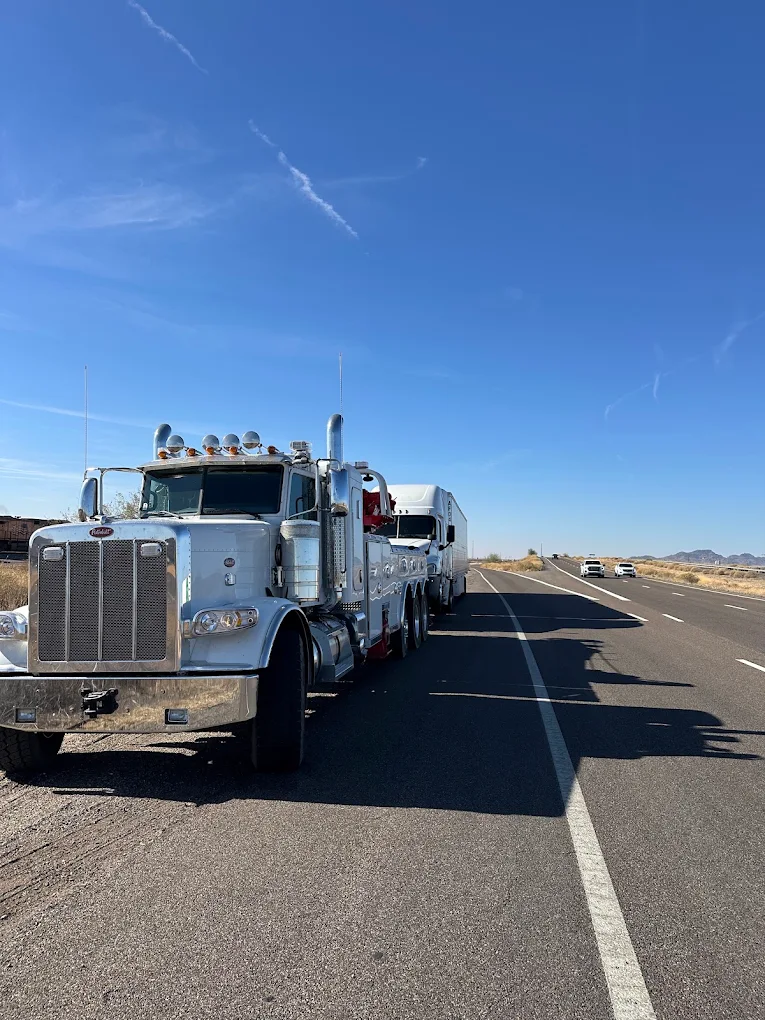
At Tucson Truck Repair & Towing, we specialize in heavy-duty recovery, semi-truck towing, and advanced commercial truck repair throughout Tucson and Southern Arizona. Our equipment includes a 35-ton wrecker and a 50-ton rotator for demanding truck and trailer recovery situations.
What Is Heavy-Duty Recovery?
Heavy-duty recovery is the process of moving a commercial vehicle that cannot be handled through routine towing. It may involve recovering a truck from a ditch, uprighting an overturned trailer, repositioning a jackknifed combination, or towing a vehicle after a major mechanical failure.
Semi trucks require specialized recovery methods because of their weight, size, cargo, and mechanical complexity. A recovery team must evaluate the tractor, trailer, surrounding terrain, road conditions, and visible damage before moving the vehicle.
Heavy-duty recovery may be required to:
- Upright an overturned tractor-trailer
- Recover a truck from a ditch, embankment, or soft shoulder
- Reposition a jackknifed tractor and trailer
- Extract a truck stuck in sand, mud, or uneven terrain
- Move a vehicle with axle, suspension, or driveline damage
- Tow a truck after an engine or transmission failure
- Remove a disabled commercial vehicle from a traffic lane
- Transport a damaged semi-truck and trailer to a repair facility
Each incident requires a specific recovery plan. Using undersized equipment or applying force from the wrong direction can damage the frame, suspension, trailer, driveline, or cargo.
How Is Heavy-Duty Recovery Different From Roadside Assistance?
Heavy-duty recovery is different from routine roadside service because it addresses disabled, damaged, overturned, or immobilized commercial vehicles that require specialized lifting, winching, extraction, or towing. When a major mechanical problem can be repaired safely at the truck’s location, Tucson Truck Repair & Towing may perform advanced roadside repair. When the scene, damage, or repair requirements make on-site work unsafe or impractical, we recover or tow the truck to our Tucson repair facility.
Tucson Truck Repair & Towing focuses on work that requires advanced equipment and commercial truck expertise. Our services include heavy-duty towing, complex recovery, and advanced repairs involving major truck and trailer systems.
This distinction is important for drivers and fleet managers. When a semi truck develops a serious engine, transmission, clutch, differential, axle, electrical, or aftertreatment problem, we assess whether the issue can be repaired safely on-site or whether the vehicle should be recovered and transported to a properly equipped repair facility.
Why Semi-Truck Emergencies Require Heavy-Duty Towing Equipment
A tractor-trailer can weigh tens of thousands of pounds and may be carrying additional cargo. Its air-brake system, suspension, axles, driveline, fifth wheel, and trailer connections also require special consideration during towing.
Standard tow trucks may not have the lifting capacity, winching strength, or structural support needed to move a semi truck safely. Heavy-duty wreckers are built for commercial vehicles and include reinforced towing assemblies, powerful hydraulic winches, heavy booms, and stabilizing outriggers.
The correct equipment depends on the situation. A tractor with a mechanical failure on stable pavement may require a different setup than a loaded trailer resting on its side beside the highway.
Sending the proper truck and recovery equipment from the beginning can reduce delays, protect the vehicle, and help prevent additional damage.
How Does a Rotator Support Complex Recoveries?
A rotator is one of the most versatile pieces of equipment used in heavy-duty recovery. Its rotating boom allows operators to lift, pull, and reposition vehicles from multiple angles.
Tucson Truck Repair & Towing operates a 50-ton rotator for difficult semi-truck and trailer recoveries. It can be especially useful when a vehicle is overturned, positioned off the roadway, blocking access, or resting at an unusual angle.
Rotator recovery may be appropriate for:
- Overturned semi trucks and trailers
- Jackknifed tractor-trailers
- Trucks located on embankments
- Vehicles with unstable or shifted weight
- Recovery sites with limited working space
- Controlled lifting and repositioning
- Trucks that cannot be approached directly
The rotator uses outriggers to create a stable working platform. Operators can then position the boom and winch lines based on the truck’s location and condition.
The equipment alone does not determine the outcome. Operators must understand vehicle structure, load distribution, safe connection points, and how the tractor or trailer may shift while being moved.
What Happens During a Heavy-Duty Recovery?
A professional recovery begins with a detailed assessment. The truck should not be pulled or lifted until the recovery team understands the vehicle’s position, damage, and surrounding conditions.
The Scene Is Evaluated
Operators inspect the tractor, trailer, cargo, road access, terrain, traffic, and available working space. They may also identify hazards such as leaking fluids, damaged electrical systems, broken suspension components, or shifted cargo.
The team then determines the appropriate recovery vehicle, rigging equipment, and towing method.
The Vehicle Is Stabilized
An overturned or leaning truck may need to be stabilized before recovery lines can be attached. This helps prevent unexpected movement while the team prepares the vehicle.
Stabilization may also be necessary when the truck has damaged axles, a failed suspension, a disconnected driveline, or structural damage.
Equipment and Recovery Lines Are Positioned
Operators identify appropriate attachment points and position the winches, chains, straps, booms, or towing assemblies.
The direction and angle of the pull must be carefully planned. Incorrect positioning can place excessive force on the truck’s frame, axles, suspension, fifth wheel, or trailer structure.
The Truck Is Recovered
The truck may be uprighted, realigned, pulled onto stable ground, or moved away from traffic. Operators continuously monitor its position and adjust the winch tension or boom angle as needed.
Heavy-duty recovery relies on controlled movement rather than simply applying maximum force.
The Vehicle Is Prepared for Towing
Once the truck has been recovered, the team evaluates whether it can be safely operated. A vehicle with major mechanical or structural damage will usually require towing.
Additional preparation may be needed when there is damage to the driveline, axles, air system, brakes, suspension, or trailer components.
What Truck Emergencies Require Heavy-Duty Recovery?
Rollover Accidents
An overturned tractor-trailer must be stabilized before it can be uprighted. The recovery team considers the vehicle’s weight, cargo, fuel system, trailer position, and surrounding terrain.
After the truck is upright, it may still need to be towed because of frame, suspension, axle, engine, or trailer damage.
Jackknifed Tractor-Trailers
A jackknifed truck can block multiple lanes and place significant stress on the tractor, trailer, fifth wheel, and connecting components.
Recovery may involve carefully repositioning, separating, or realigning the combination before it can be transported.
Trucks Stuck Off the Roadway
Semi trucks can become stuck on soft shoulders, desert terrain, sand, mud, drainage areas, or embankments. Continuing to drive may cause the vehicle to sink deeper or lean farther.
Operators evaluate the ground and choose a recovery angle that helps return the truck to a stable surface while protecting its axles, suspension, and driveline.
Major Mechanical Failures
Some trucks require towing even when no collision has occurred. A major mechanical failure can leave a vehicle immobilized on a highway, at a truck stop, in a loading area, or along a remote freight route.
Problems that may require towing include:
- Engine failures
- Transmission or clutch problems
- Damaged differentials
- Dropped drivelines
- Electrical system failures
- Air-system problems
- Cooling-system failures
- Axle or suspension damage
- Aftertreatment system problems
These situations require more than minor roadside assistance. The truck may need to be transported to a shop capable of diagnosing and repairing advanced commercial systems.
Trailer and Axle Damage
Trailer failures can prevent the entire combination from moving safely. Burned wheel ends, damaged spindles, failed axles, brake problems, or structural damage may require recovery and towing.
Because the tractor and trailer operate as a connected combination, the recovery plan must account for the condition of both vehicles.
How Towing and Repair Services Help Reduce Downtime
Downtime directly affects trucking companies and owner-operators. A disabled truck can delay a delivery, interrupt another scheduled load, reduce available driving time, and increase towing or storage costs.
Working with a company that provides both heavy-duty towing and advanced repair can make the process more efficient. Instead of transporting the truck to a facility that may not be equipped for the problem, it can be taken to a shop that handles complex semi-truck repairs.
Tucson Truck Repair & Towing works on:
- Engines and engine-related problems
- Transmissions and clutches
- Differentials and drivelines
- Electrical and wiring problems
- Air systems
- Radiators and cooling systems
- Aftertreatment systems
- Axles and trailer components
- Major truck and trailer repairs
Our technicians also use manufacturer-level diagnostic software and vehicle-specific wiring information to identify difficult problems. This combination of recovery, towing, diagnostics, and repair helps move the truck from the emergency scene into the repair process without unnecessary stops.
Why Southern Arizona Experience Matters
Commercial truck emergencies in Southern Arizona can involve high temperatures, long distances, desert terrain, soft shoulders, and limited repair options between cities.
Drivers traveling through Tucson, Benson, Willcox, Dragoon, Eloy, Bowie, Marana, San Simon, and Nogales may be far from their regular service provider when a major breakdown occurs.
We evaluate whether the truck requires recovery, towing, advanced roadside repair, or transport to our repair facility. Tucson Truck Repair & Towing can also tow a semi truck and trailer together when the vehicle’s condition and recovery circumstances allow.
Heavy-Duty Recovery and Semi-Truck Towing in Tucson, AZ
Heavy-duty recovery supports truck emergencies by safely stabilizing, extracting, repositioning, and towing disabled commercial vehicles. It is intended for major incidents, not routine tire changes, jump-starts, or basic maintenance services.
Tucson Truck Repair & Towing focuses on demanding semi-truck and trailer work, including heavy-duty recovery, commercial towing, advanced diagnostics, and complex repairs. With a 35-ton wrecker, a 50-ton rotator, and experience with major truck systems, we are prepared to handle serious commercial vehicle emergencies throughout Tucson and Southern Arizona.
Contact us at 520-665-9550 for heavy-duty recovery, semi-truck towing, or advanced truck repair in Tucson and the surrounding region.